Questions before
component selection.
Find answers by product responsibility, then confirm the exact configuration, operating limits and interfaces.
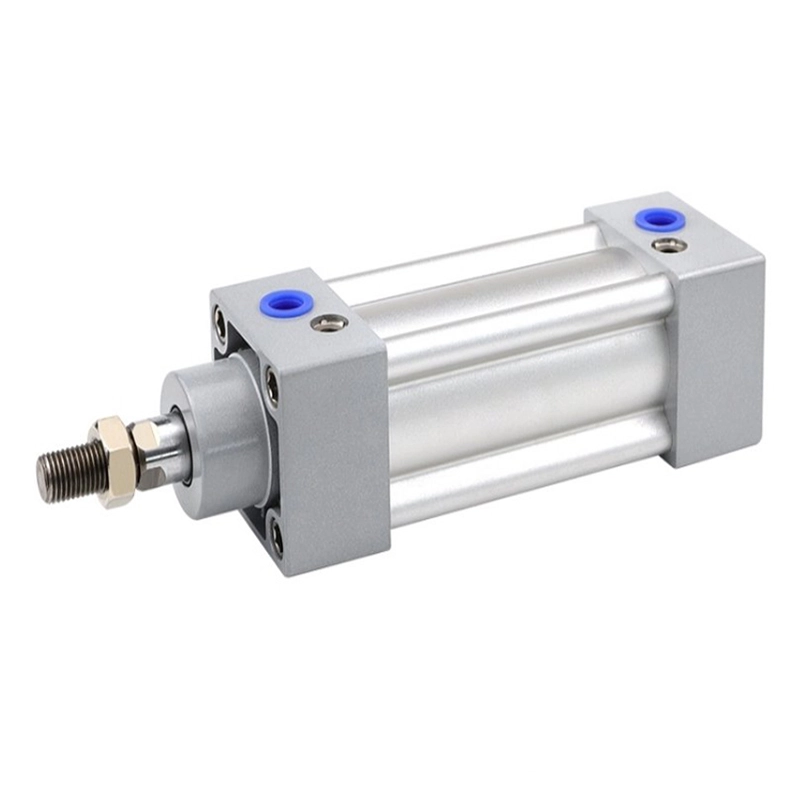
Actuators
Use each answer with the relevant model data and installation requirements.
Are all standard-cylinder series dimensionally interchangeable?
Fit must be checked against the selected cylinder drawing. Compare mounting centres, rod thread, body length, port locations and accessory dimensions; a common bore and stroke do not establish interchangeability.
Review standard pneumatic cylindersIs proof pressure an operating pressure?
No. Operating pressure and proof pressure are separate ratings. Size and run the actuator within its operating range. Proof pressure is a test reference and is not an operating setpoint.
Review standard pneumatic cylindersCan one port adapter be used across all mini cylinders?
Check each bore and series. A bore used with M5 in one platform may use a pipe port in another. Confirm thread form as well as nominal port size.
Review mini pneumatic cylindersCan I size a guided cylinder by thrust alone?
No. Select bore for axial force with an application margin, then check side load and moment independently. Guidance capacity is not established by the thrust table.
Review guided pneumatic cylindersValves
Use each answer with the relevant model data and installation requirements.
How do 3/2, 5/2 and 5/3 differ?
The first number identifies the ports and the second the switching positions. A 3/2 circuit commonly serves a single-acting actuator or pilot signal; 5/2 switches a double-acting actuator. A 5/3 circuit adds a centre state that must match the machine circuit.
Review pneumatic solenoid valvesDoes a 5/3 closed centre guarantee that a cylinder holds its load?
The centre symbol is one part of the circuit. Valve centre state alone does not establish a load-holding or machine safety function; check the required behaviour for the actuator, load and complete circuit.
Review pneumatic solenoid valvesWhich electrical details belong in a requirement brief?
Specify AC or DC, rated voltage, connector or cable entry, single- or double-solenoid control and any manual-override requirement.
Review pneumatic solenoid valvesDoes every 2W valve operate at zero differential pressure?
The operating principle varies with size and construction. Confirm the minimum differential pressure and exact model before using a 2W valve on a gravity-fed or low-pressure line.
Review fluid control valvesCan a different seal make any valve suitable for steam or chemicals?
The body, internal materials, actuator or coil, temperature and pressure must also suit the actual medium and concentration.
Review fluid control valvesWhat should I check when selecting an HSV slide valve?
Confirm the 3/2 flow function, connection size, male/female thread arrangement and installation space. If the application includes maintenance isolation or lockout, specify that requirement separately so the device and machine procedure can be assessed.
Review manual control valvesAir preparation and connections
Use each answer with the relevant model data and installation requirements.
Does every circuit need a lubricator?
Include a lubricator only when downstream equipment specifies air-line lubrication. Check that the components and process are suitable for oil mist.
Review a series frl unitsDoes a matching name confirm a replacement?
Match the full code, thread, port centres, bracket holes, gauge position and bowl clearance. The series name alone does not confirm mechanical interchangeability.
Review a series frl unitsShould I order by tube OD or ID?
Use tube outside diameter for push-in fittings. Also specify material and verify dimensional tolerance and surface condition.
Review push-in fittingsCan I use the tube’s higher pressure rating for the assembly?
The allowable assembly pressure is limited by its lowest-rated tube, fitting, valve or other component at the actual temperature and medium conditions.
Review push-in fittingsWhy specify both OD and ID?
The nut must suit tube OD while the internal support must suit its ID. Different wall thicknesses can share an OD and require a different connection.
Review rapid nut-locking fittingsAre pressure ratings valid at every temperature?
The pressure columns apply at the stated test temperature. Confirm a derating curve for the material and size before using another temperature.
Review pa nylon tubingNeed a drawing or
a fuller selection brief?
Use the complete code and actual operating conditions when matching a reference to your requirement.
Prepare a component brief
List the full model, interfaces and document references. The brief tool creates text on your device to copy or download.
Create a component brief