Compact pneumatic
cylinders.
Short-body formats for clamping, ejecting and fixture motion. Compare four platforms by mounting envelope, sensing and the complete model code.

Four compact platforms.
Compare the installation.
Check the complete mounting envelope, sensing needs and model code. A common bore and stroke do not establish matching installation dimensions.
SDA Series
Compact bodies with separate magnet and non-magnet stroke selections. Set the sensing requirement before choosing bore and stroke.

MD / MK Series
MD is the multi-mount family. MK adds a non-rotating rod arrangement and uses its own MK/MSK/MTK/MKD/MKJ codes; MD parameters do not rate MK.

CQ2B Series
Confirm the complete cylinder code and mounting drawing. The ACQ-coded reference tables below describe ACQ configurations and do not establish CQ2B specifications or replacement fit.

ACE Series
Common ACE and non-rotating TACE selections. Compare the yoke clearance, stroke envelope and actual mounting drawing.
Mounting, sensing
and rod guidance.
The short body is one part of the installation. Compare mounting faces, feedback options and the tool arrangement before choosing bore and stroke.
| Series group | Format and options | What to confirm |
|---|---|---|
| SDA Series | Compact body; magnet or non-magnet | Choose the sensing configuration first. Magnet-equipped and non-magnet models have different listed stroke limits. |
| MD / MK Series | Multi-mount MD platform | Numerical selection covers MD-coded variants. Confirm the complete supplied code and the required mounting faces. |
| CQ2B Series | Compact format; code-specific selection | The reference tables describe ACQ/ASQ/ATQ-family codes. CQ2B specifications and replacement fit require separate model and drawing confirmation. |
| ACE Series | Common ACE or non-rotating TACE yoke | Choose the rod configuration before stroke. Check yoke clearance, port positions and any external guidance for offset loads. |
A compact shape does not establish dimensional interchangeability. Compare mounting holes, rod projection, port positions and switch clearance against the complete model drawing.
Series-specific
technical data.
Open a series for its operating conditions, configuration and stroke selection. Keep the listed acting, magnet and bore qualifiers with the complete model code.
SDA SeriesOperating data · Magnet and acting variants
SDA compact cylinder selection
SDA compact cylinders have different acting types, sensing options and rod arrangements. Compare the model and magnet option before choosing a stroke or mounting envelope.
Use the series reference for model-specific bore, stroke, port thread and installation dimensions. Confirm the complete offered code and current drawing before ordering.
MD / MK SeriesMD specifications and dimensions · Separate MK platform
MD is the multi-mount platform; MK uses a non-rotating rod arrangement with separate MK/MSK/MTK/MKD/MKJ configurations. Use the MD series detail for MD specifications; MK requires its own specifications and drawing. Include the complete series code and dimensioned drawing for either platform.
MD multi-mount cylinder selection
Compare MD double acting, MSD push type, MTD pull type, MDD double rod and MDJ adjustable-stroke configurations in the MD series detail.
Check the model-specific stroke range, magnet selection, rod thread and complete installation drawing before ordering. MK is a separate non-rotating platform and requires its own specifications.
View full series specifications and dimension references
MK non-rotating cylinder selection
MK uses a non-rotating plate and fixed rods. Compare MK, MSK push, MTK pull, MKD double-rod and MKJ adjustable-stroke configurations against their own pressure, stroke and dimension tables. Confirm the complete offered model, load and installation drawing; MD dimensions do not establish MK fit or ratings.
ACQ-coded configuration referenceACQ-family data · Stroke and port selection
The published compact-platform codes are ACQ, ASQ, ATQ, ACQD and ACQJ. Confirm the complete supplied model code and drawing for the required configuration.
Scroll the table sideways to compare all variant, bore, port and stroke columns. Keyboard: focus the table area, then use the left and right arrow keys.
| Variant | Acting | Bore (mm) | Port size | Listed standard strokes (mm) | Max (mm) |
|---|---|---|---|---|---|
| ACQ | Double acting | 12 | M5×0.8 | 5 10 15 20 25 30 35 40 45 50 | 50 |
| ASQ / ATQ | Single acting | 12 | M5×0.8 | 5 10 15 20 | 20 |
| ACQ | Double acting | 16 | M5×0.8 | 5 10 15 20 25 30 35 40 45 50 55 60 | 60 |
| ASQ / ATQ | Single acting | 16 | M5×0.8 | 5 10 15 20 | 20 |
| ACQ | Double acting | 20 | Rc 1/8 | 5 10 15 20 25 30 35 40 45 50 60 70 75 80 90 100 | 100 |
| ASQ / ATQ | Single acting | 25 | Rc 1/8 | 5 10 15 20 25 30 | 30 |
| ACQ | Double acting | 32 / 40 / 50 / 63 | 32: Rc 1/8 40–50: Rc 1/4 63: Rc 3/8 | 5 10 15 20 25 30 35 40 45 50 60 70 75 80 90 100 | 100 |
| ASQ / ATQ | Single acting | 50 | Rc 1/4 | 5 10 15 20 25 30 | 30 |
| ACQ | Double acting | 80 / 100 | Rc 3/8 | 5 10 15 20 25 30 35 40 45 50 60 70 75 80 90 100 | 100 |
These ACQ-coded configurations are provided as a separate reference. Confirm the complete supplied series, code and dimensioned drawing; do not assume CQ2B interchangeability.
Scroll the table sideways to compare all variant, bore, port and stroke columns. Keyboard: focus the table area, then use the left and right arrow keys.
| Variant | Acting | Bore (mm) | Port size | Listed standard strokes (mm) | Max (mm) |
|---|---|---|---|---|---|
| ACQ | Double acting | 125 / 140 / 160 | Rc 3/8 | 10 20 30 40 50 75 100 125 150 175 200 250 300 | 300 |
These ACQ-coded configurations are provided as a separate reference. Confirm the complete supplied series, code and dimensioned drawing; do not assume CQ2B interchangeability.
ACE SeriesOperating data · Separate ACE and TACE stroke tables
ACE and TACE compact cylinder selection
ACE and TACE use different rod arrangements and stroke selections. Match the model before comparing the installation envelope.
Use the series reference to compare bore, stroke, rod thread, sensing and dimensions. Confirm the complete offered code, current drawing and clearance for the moving tool before ordering.
Short body.
Leave room for the tooling.
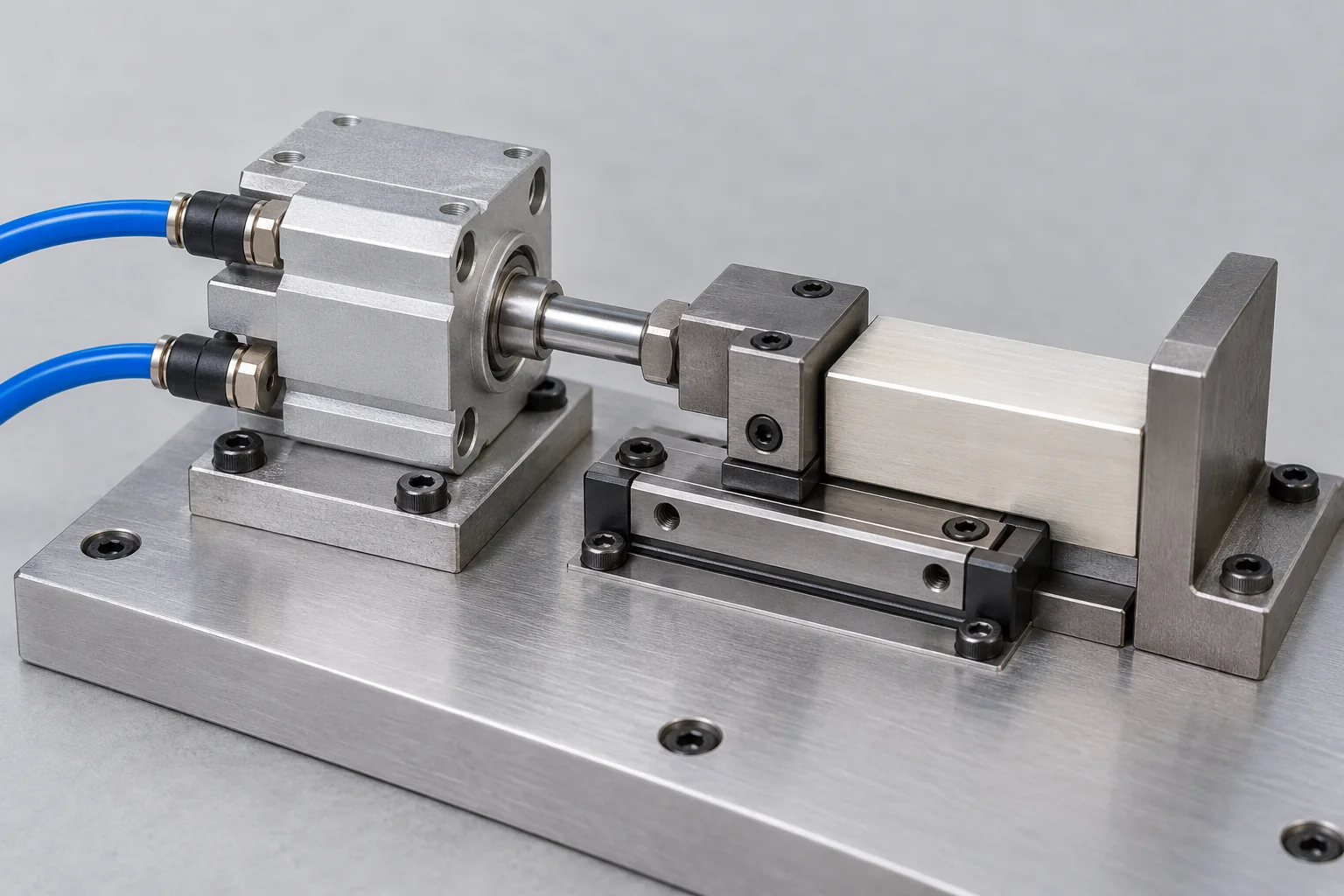
Include rod travel, fittings and sensor access in the installation envelope. Check the tool’s rotation and external guidance requirements together.
New machine
Define the load direction, clamping or ejecting motion, full travel and space around the tool. Record sensing needs and any required external guidance.
Replacement
Record the full model, bore and stroke. Compare mounting holes, body length, rod projection, ports and sensing with the existing machine. Keep reference photos ready to share.
- Measure the complete mounting envelope
- Check body length, rod projection, mounting-hole positions and fittings with the cylinder fully retracted and extended. Allow room for the rod, fittings and sensor access.
- Separate magnet and non-magnet selections
- The SDA stroke selection distinguishes magnet-equipped and non-magnet models. Fix the feedback requirement before choosing the stroke and confirm switch clearance.
- Treat the compact platforms separately
- Treat SDA, MD, MK and ACE as distinct platforms. Use the ACQ-coded tables only for the separate ACQ reference platform. For a replacement, supply the complete old code and dimensioned drawing; do not assume CQ2B interchangeability.
- Add non-rotation when tooling needs it
- ACE includes the TACE yoke configuration. Choose the non-rotating selection when rod rotation would affect the tool, and provide any offset-load requirement separately.
Check the details.
Prepare the requirement.
Use the new-machine and replacement checklists alongside the selected cylinder data.
Common questions.
Which dimensions matter for a compact-cylinder replacement?
Compare mounting holes, body length, rod projection, rod thread, port position and switch clearance. Confirm the complete drawing before treating a compact platform as a replacement.
Why are magnet-equipped SDA strokes listed separately?
Magnet-equipped and non-magnet variants have different listed stroke limits. Choose the sensing configuration first and use its corresponding row.
What is the difference between ACE and TACE?
ACE is the common compact format. TACE adds a yoke for non-rotating motion and has its own bore and stroke selection. Check yoke clearance and the mounting drawing.
Are double-acting and single-acting limits the same?
No. Working pressure and speed distinguish the acting types, and the single-acting stroke selection is shorter. Use the row for the required action and complete code.
Bring the cylinder
details together.
Record the complete model, acting type, bore, stroke and sensing needs. Add body and mounting dimensions, rod end, ports, tooling guidance, quantity and schedule.
Create a compact-cylinder briefCopy or download your component requirements.
- Model and sensing
- Full code / acting type / bore / stroke / magnet
- Fit and motion
- Body / mounting / rod end / ports / guidance
- Application and order
- Load / tool action / quantity / schedule