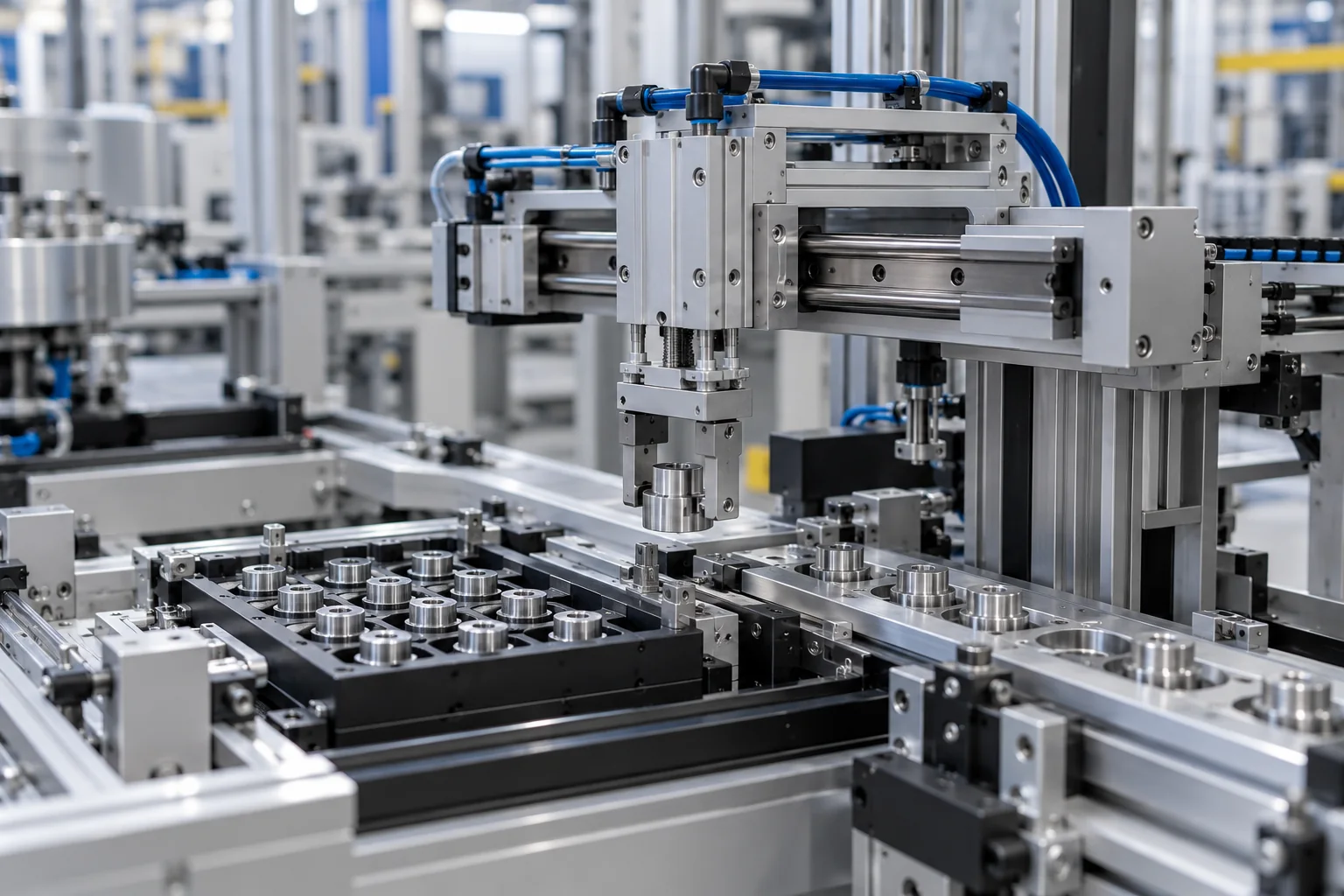
Pneumatic components.
For your machine.
From packaging lines to assembly fixtures and compressed-air supply, begin with the operating task. Connect the motion, control and air-line requirements before selecting a component.
Transfer and assembly · AI-generated concept.
Illustrative context, not a customer installation.
Start with the machine.
Then define the circuit.
A cylinder, a directional valve and an air-preparation unit perform different jobs. The machine task determines the required motion; the circuit defines how air is switched, regulated and routed. Review the two together before choosing a series or substituting a component.
JEMWON manufactures fittings and tubing and also works as an experienced distributor, bringing procurement and project experience together with a network of 10 supplier factories. These guides connect installation requirements to the available product categories and their model-specific information.
- Packaging machines
- Index, push and position packs while reviewing cycle demand, installation space and air routing.
- Automation & assembly
- Coordinate moving loads, guides, fixture interfaces and control signals.
- Compressed-air systems
- Review the supply condition, point-of-use pressure, flow demand and line connections.
Three machine contexts.
Choose the guide closest to the task, then review the component interfaces and operating conditions.

Packaging machines
Carton indexing, pushing and positioning place the actuator inside a repeated machine sequence. Review the moving load and stroke with the valve response, air demand and connection space.
- Product starting point
- Compact cylinders, directional valves and push-in fittings
- Review together
- Load, stroke, cycle timing, mounting envelope, coil supply and air-line route.
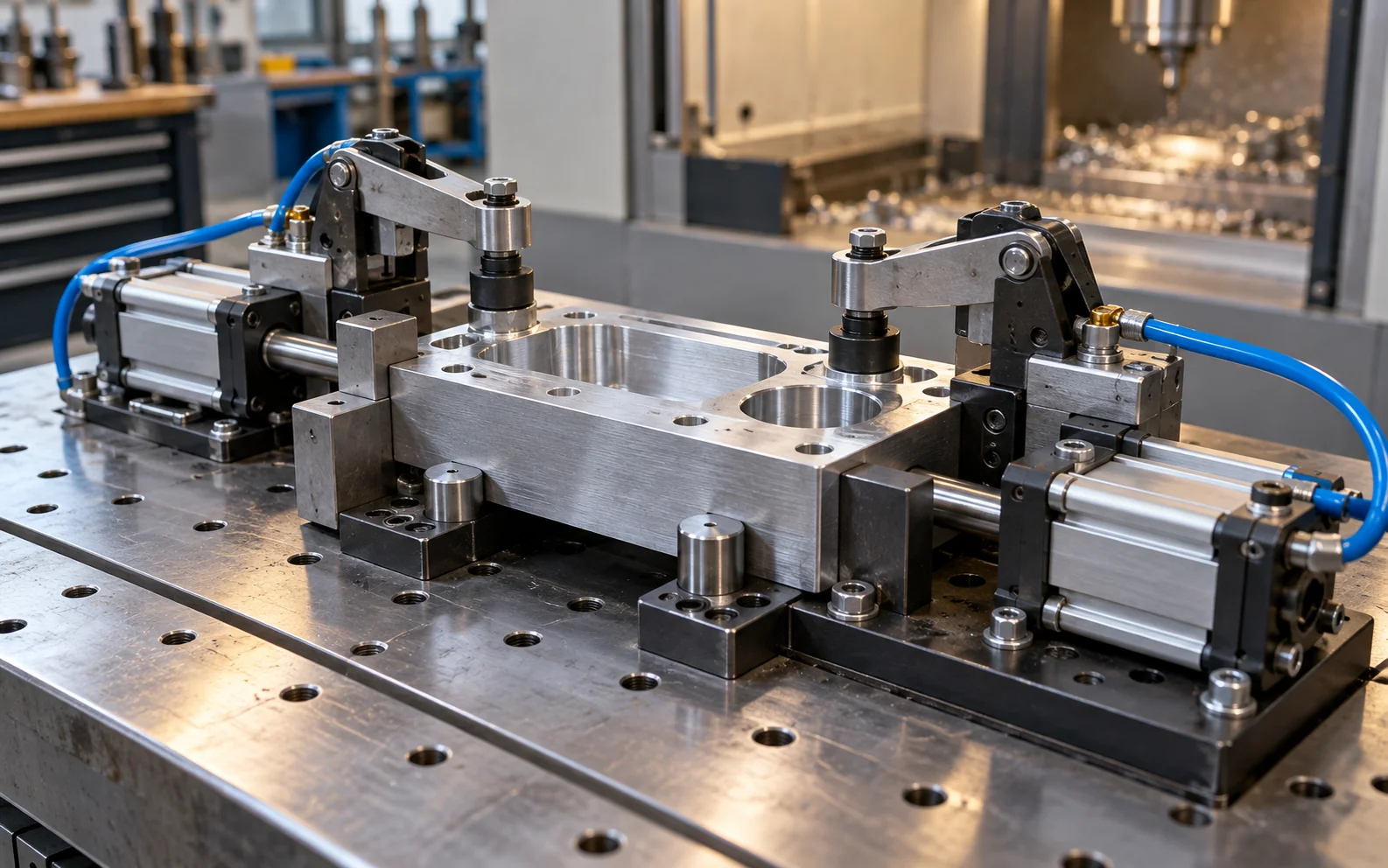
Automation & assembly
Transfer axes and assembly fixtures need a defined load path and repeatable mechanical interfaces. Select the cylinder or slide format with the guide, tooling, sensing and pneumatic circuit.
- Product starting point
- Guided cylinders, slide tables and directional valves
- Review together
- Payload and overhang, travel, mounting faces, position signals and moving-tube clearance.

Compressed-air systems
The air supply must be reviewed at the point where the machine uses it. Filter, regulator, tubing and connection choices depend on the required flow, pressure and downstream air quality.
- Product starting point
- Air preparation, fittings and tubing
- Review together
- Peak and simultaneous demand, inlet pressure, pressure loss, condensate handling and service access.
Match the component to its job.
The application gives the context. The exact load, circuit, installation and operating conditions narrow the selection.
On a small screen, scroll the comparison sideways to read all columns.
| Machine function | Product starting point | Configuration to establish |
|---|---|---|
| Compact linear motion | SDA compact cylinders | Load, stroke, acting type, mount, rod end and available travel space. |
| Guided travel / tooling interface | TN / TR and HLQ / HLQL | Load and moment, orientation, guide format, table or end-plate mounting and position sensing. |
| Pneumatic direction control | 4V / 3V valves | Valve function, positions, normal state, flow, coil supply, ports and exhaust arrangement. |
| Local air preparation | AF / AW / AR | Inlet conditions, flow at required pressure, filtration, drain and downstream lubrication requirements. |
| Tube-to-port connection | PC / PL fittings | Tube outside diameter, port thread standard and size, connection direction and wrench clearance. |
| Air routing | PU / PA6 / PA12 tubing | Actual grade, outside/inside diameter, route, bend space, movement and pressure–temperature conditions. |
A shared series name or nominal port size does not establish interchangeability. Review the complete model designation and selected configuration.
Give the review a clear starting point.
Keep the machine task, circuit and installation in one requirement.
Motion and circuit duty
Moving load, orientation, stroke, timing, intended valve function and the operating sequence.
Physical interfaces
Mounting drawing, rod or table connection, port thread, tube sizes, connection directions and access for service.
Air and controls
Normal and peak pressure, flow demand, temperature, air treatment, coil supply and position-sensor interface.
From the scene
to the specification.
Use the selected product page for the available series data and source references. A machine photograph cannot establish dimensions, pressure limits or control compatibility.
Identify the exact model and document revision before using a drawing for installation.
- Browse product categoriesFind the relevant series, operating data and the source references available for that category.
- Review available documentationSee what is actually available and which selected-model documents still need confirmation.
- Prepare a new-machine checklistRecord the load, circuit, mounting, connections, quantity and required documentation.
- Prepare a replacement checklistRecord the full existing model, nameplate, interfaces and the changes that can be accepted.
Application questions.
A useful shortlist starts with the task and finishes with a defined model and interfaces.
Prepare a requirement briefThe current brief tool creates text in your browser for copying or downloading.
Does an application determine a component’s rating?
It establishes the context. The exact product configuration, operating conditions and machine requirements determine which ratings and interfaces must be checked. No common pressure, temperature or flow rating is assigned to every product on these pages.
Are the application photographs customer installations?
No. The visible captions identify AI-generated concepts. They illustrate the type of machine or air circuit being discussed and do not show a documented JEMWON customer project, factory, exact model or validated complete machine design.
Which products does JEMWON manufacture?
JEMWON has in-house manufacturing of fittings and tubing. Its broader pneumatic range also draws on distribution, procurement and project experience with a network of 10 supplier factories. Manufacturing origin and documents should be confirmed for the selected item.
What should a configuration brief include?
Include the machine task, candidate model, load or flow requirement, normal and peak operating conditions, circuit and installation interfaces, quantity, destination and required documents. For a replacement, retain the full existing designation and identify which interfaces must stay unchanged.
Can these guides confirm a safe stopping or holding function?
The guides identify general pneumatic selection inputs. Machine risk assessment, isolation, stored-energy control and any required safety-rated architecture must be established for the actual machine; a standard cylinder or directional valve is not presented here as a validated safety device.